Talk:Flag of the United States
|
|
An event mentioned in this article is a June 14 selected anniversary
| Contents |
Details
Having to do with the specifications of the flag
Image size
Would the majority of the Wikipedian community be willing to reduce the size of this flag image to, say, no more than two-thirds what it is now? I assume it's a function of the refresh rate on my old monitor (like the flashing light in The Andromeda Strain that triggered the seizure), but this large flag gives me vertigo, and I had not had any trouble with the smaller one that was here before. Since I think the effect has to do with the size of the stripes, and we can't go larger, I'm asking that we go enough smaller to throw my monitor rate (or my brain rate, if that's the problem) that's causing it out of sync with the stripes so I don't get dizzy and queasy looking at it. (I'm assuming that if it's happening to me, it's happening to a few other people, too, but that may not be true.) We wouldn't lose any information by it, but (I hope) I could lose the discomfort. -- isis 23:45 Oct 14, 2002 (UTC)
- It is a little wide but there is no text flowing around. But the image use policy does say to generally not have images wider that 400 pixels so I will resize it down to 400 pixels wide and see if that helps. --mav
- You will have to hit refresh to see the new image, but how is that? Still have the funny screen problem? --mav
- Anyone think it could stand to be redone to use the new 'thumnail box' for images?
Proportions (from Image_talk:Us_flag_large.png)
- The executive order listing proportions can be found here [1] (http://assembler.law.cornell.edu/uscode/html/uscode04/usc_sec_04_00000001----000-notes.html). Look to the far bottom of the page
--Jacobolus 06:46, 13 Feb 2005 (UTC)
Color specifications
I've altered the colors to meet US government specifications. The US flag is a great deal darker in color than people realize. Here it is Image:Us flag large colorspec.png, so you can take a look and see if you want to replace the very bright version on the wiki page with something closer to the proper colors Dogface
- I copied a larger version from the CIA world factbook. Press CTRL F5 on the page and tell me what you think of that one. --Jiang 22:34, 24 Nov 2003 (UTC)
Color specifications 2 (from Image_talk:Us_flag_large.png)
The following is quoted text:
The official regulation, which I just tracked down at the Defense Technology Information Center website http://www.dtic.mil is General Services Administration "Federal Specification, Flag, National, United States of America and Flag, Union Jack," DDD-F-416E, dated November 27, 1981. It specifies the colors by reference to "Standard Color Cards of America" maintained by the Color Association of the United States, Inc. These are:
- Cable No. 70180 Old Glory Red
- Cable No. 70001 White
- Cable No. 70075 Old Glory Blue
Joe McMillan, 25 January 2000
Old Glory Red (PMS 193C), White, and Old Glory Blue (PMS 281C)
(From: http://www.fotw.us/flags/us.html)
According to this site [2] (http://www.sbedirect.com/data/download/vrac/pantone.html) these colors in RGB are:
- Old Glory Red: BF0A30
- Old Glory Blue: 002868
—Cantus…☎ 09:03, Jan 31, 2005 (UTC)
The official colors given by the US Embassy in London [3] (http://www.usembassy.org.uk/rcflags.html):
- Old Glory Red: PMS 193C (Solid Color, Coated) = RGB 191, 10, 48 = BF0A30
#BF0A30
- Old Glory Blue: PMS 281C = RGB 0, 40, 104 = 002868
#002868
- White = RGB 255, 255, 255 = FFFFFF
#FFFFFF
--Jacobolus 23:48, 15 Jan 2005 (UTC),
Earlier flags
Hey, it would be really nice to have pictures of some of the earlier versions of the flag - any available?207.189.98.44 22:02, 8 Jan 2004 (UTC)
- I second this. It's cool having the first flag, but it would be even cooler to have an image of every flag between that one and our present one. --Lukobe 20:04, 8 Aug 2004 (UTC)
- Done. --Jacobolus 01:55, 16 Feb 2005 (UTC)
Most changed flag?
Is the United States flag the national flag that has changed the most number of times? We must have changed it at least ten times to add in new stars. Kent Wang 05:13, 29 May 2004 (UTC)
- Dunno if it's the most, but I just noted there have been 26 changes over the years. Tempshill 19:16, 7 Jul 2004 (UTC)
- Yup. I just added pictures. It sure is a lot of changes. Lots of the flags had no real official pattern for the stars either, so while the ones I put there are the most common (Military, etc), there were lots of other designs in concentric rings, big star shapes, etc. --Jacobolus 01:54, 16 Feb 2005 (UTC)
Puerto Rico
There's only one good reason that Puerto Rico shouldn't be a state, and that's that they'd spoil our flag design! - Woodrow, Emperor of the United States 01:20, 13 Apr 2004 (UTC)
- Actually, http://flagspot.net/flags/us51star.html doesn't look half bad... --Random832 21:21, 2004 Jun 14 (UTC)
Questions
Cuba
How come Cuba's(a communist nation) flag is influenced by US' flag ??
Civil flag
The article said:
- Before the American Civil War, the United States had two flags: the military flag (as described above) and the civil flag, whose stripes were vertical and whose stars were blue on white. [4] (http://iresist.com/cbg/hornswog.html)
I've moved this here because the cited web-page makes it look like nonsense. Does anyone have any evidence that it isn't nonsense? It's quite likely that there's a grain of truth in it somewhere, but I'm not sure where. The US has had many flags for different purposes, but the various flag acts make it clear that (from 14 June 1777) there has only been one flag which is the flag of the United States, and it has white stars in a blue field. --Zundark, 2001 Nov 3
- I've found a couple more web references, but not enough to justify putting it back yet: http://www.barefootsworld.net/uscivilflag.html and the similar http://www.civil-liberties.com/pages/mystery_of_the_flag.htm tell a slighly different version than the hornswoggle page. http://www.crwflags.com/fotw/flags/us-librt.html shows a vertically-striped flag that predates the US flag and has tons of other great flags (click the links). --DanKeshet
http://www.midcoast.com/~martucci/flags/us-hist1.html also has quite a bit of info on different US flags. In particular, the section called The Eagle Standard shows a flag with vertical stripes (the one with an eagle in the corner). The status of the flag with blue stars on white is still unclear to me, however, because the original resolution defining the US flag certainly didn't allow this (whereas it did allow vertical stripes). --Zundark, 2001 Nov 3
- After becoming aware of the shenanigans re the civil and military US flags, I have seen images of the civil flag flying over US Customs houses. One, a photo on the 'net from Alaska 1997.[5] (http://www.outlawslegal.com/organic/flag.htm) Two, a mid-2003 Atlantic TV news video about a non-flag matter showed it over the Calais-St Stephen crossing. The familiar, daily-genuflected military flag was not visible in the second case. (Ain't mem'ry a wonderful thing. I'm no longer sure of the 2nd instance; what I remember had fewer stripes. But it wasn't the flag of ME[6] (http://www.midcoast.com/~martucci/flags/maine/flaglaw.html), NB, or Canada.)
- For ref: The Scarlet Letter contains: "From the loftiest point of [the Custom house] roof...floats or droops, in breeze or calm, the banner of the republic; but with the thirteen stripes turned vertically, instead of horizontally, and thus indicating that a civil, and not a military post of Uncle Sam's government, is here established."[7] (http://www.bartleby.com/83/101.html) This has clinched it for me; that flag existed. Now, what happened to it?
- I am no lover of Yankee imperialism, but this whole "civil flag" myth is founded on a very thin thread that is contrary to all contemporary documentation and artifacts. (http://www.webleyweb.com/klh/flag.html) -- a worthy contrary argument grounded in original codices which "I can assure you that none of Lincoln's fellow travellers have been able to get to them to alter their contents": the direction of the stripes was uncodified until an act of 1818 April 4 (effective 1818 July 4); the 1777, 1794, and 1818 flag laws refer to a "flag of the US" only, with no civil, military, naval distinctions; but there was a flag with 16 vertical stripes created in 1799 for an overseas-trade revenue agency (http://www.uscg.mil/hq/g-cp/history/1799Ensign.jpg). (Looks like this flawed idea of two US flags is at least 150 years old =)
This "Eagle Standard" sounds a lot like the US Coast Guard Flag (http://flagspot.net/flags/us%5Ecg.html) --Random832 21:28, 2004 Jun 14 (UTC)
The Great Seal
The flag was based partially on the shield of arms depicted on the Great Seal of the United States; - isn't it the other way around? RickK 03:13, 18 Nov 2003 (UTC)
Apollo 11 flag
I've changed teh reference regarding the Apollo11 flag beign replaced. I can find no evidence that the flag was replaced, or that any later apollo missions even revisited the apollo11 site.
This image seems to back this up:

--Nemo
Mirrored flag
Is there any reason why the US Army has the Flag inverted on the soldiers' right arm (stars to the left)?
Also, when the Flag is hung as a tapestry (stripes vertical), the stars are to the left, not to the right, which it should be if the Flag is rotated 90° clockwise?
CS Miller 12:55, Apr 29, 2005 (UTC)
Circular re-direct
No circular re-directs, please! 66.245.2.114 17:30, 15 May 2004 (UTC)
Betsy Ross Flag proportion
Hi, I made the betsy ross flag in the same ratio (10:19) as all the other flags, but I think probably most flags that were made during the revolution were in fact shorter than that. Should I leave them all the same size for consistency, or should I reduce the Betsy Ross flag, and if so, to what proportion. Also, should the Betsy Flag have stars moved closer together? Let me know what you all think at my talk page. --Jacobolus 12:33, 19 Feb 2005 (UTC)
History section placement
Should Flag of the United States#History really be at the bottom of the page? I think it's pretty important, and probably belongs before traditions, etc. The Historical Star Patterns section definitely belongs at the bottom, being long - elsewhere it would break up the flow, but I think history should be moved back to the top of the page where it was. --jacobolus (t) 11:13, 16 Mar 2005 (UTC)
- I disagree, but you'd expect me to, since I'm the editor who moved "History" to the bottom of the page. <g> My main motivation in the move was that "Historical star patterns" should be a subsection of "History", and I find it really odd to have one history section, then some other stuff, then another history section.
- I also don't see that how close something is to the top of the article has anything to do with its importance (excluding whether or not it appears in the introduction). This is not a newspaper article, where the stuff at the bottom might get cut off because we don't have enough space. Moreover, as it happens, when I was a kid, my family had a copy of World Book Encyclopedia, and I seem to recall that the "History" section of an article was always the last one before the standard appendices. (Alas, I may have just shot myself in the foot, depending on how much contempt people around here have for World Book. <g>) — DLJessup 14:37, 17 Mar 2005 (UTC)
Removal of Taiwanese Flag
I have removed the Taiwanese flag from the Flags with similar design section of the article for the following reasons:
- There are no stars on the flag that are similar to those on the US flag. The star that is there is based on an indigenous Chinese design from the 19th century.
- There are no stripes on the flag.
- The fact that a Canton is in the top left corner is not indicative of the flag being of similar design. Many flags have Cantons, and these are not based upon the US flag.
- The fact that the flag has Red, White and Blue colours is not indicative of a basis upon the US flag.
For more information, see:
- The Taiwanese Flag
- Blue Sky with a White Sun
- Flag terminology
- Flag of Australia - a flag with a canton... but you try telling Australians that their flag is based on the US one!!! ;)
--One Salient Oversight 05:17, 3 Apr 2005 (UTC)
Interesting historical flag reference
http://www.magazinusa.com/lv2/hist/i_hist_flag.asp -- 06:57, 17 May 2005 (UTC)
- I just looked at the above link. The site is in German — but it shows several historical U.S. flags, including some designs which do not appear in this article. — DLJessup 13:07, 24 May 2005 (UTC)
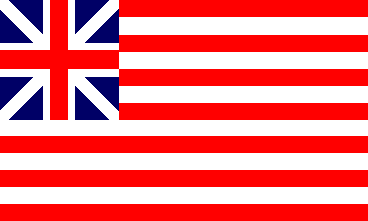
Can someone make a US Grand Union Flag image?
It's the missing piece of the flag evolution section.
There's an example of it at Flagspot (http://flagspot.net/images/u/us-gu.gif)
I'm not very good with the GIMP, and I keep messing up. Two points to remember:
- use the offical color palette mentioned above, so that it matches the other US flags displayed here
- The blazon should match the old British Union flag, not the present one which wasn't created until 1801, i.e., there should be no red in the diagonal bars (bends if you want to get technical). I'm attaching an example.


Thanks to anyone who can do this! --Jpbrenna 02:48, 21 May 2005 (UTC)
Symbolism
I am reverting the insertion of the following paragraph by an anonymous user:
- The Second Continental Congress of June 14, 1777 chose the colors of the flag by using certain colors' traditional symbolism as follows: red, for valor, bravery, and the blood of the fallen; white, for purity and innocence of the new nation; and blue, for vigilance, perseverance, and justice. The stars are considered a symbol of the heavens and the divine goal to which man has aspired from time immemorial. Currently, there are fifty stars for fifty states. While the stripes are symbolic of the rays of light emanating from the sun; there are thirteen stripes representing the original thirteen colonies.
While I have heard of the symbolism described above, to the best of my knowledge most of the above meanings were created after the flag was, in a manner similar to how backronyms are created to "explain" a pre-existing term. In any case, I would like a citation for the above assertions before they are entered into the article.
— DLJessup 03:49, 14 Jun 2005 (UTC)
- It looks like the removal was probably justified[8] (http://www.usflag.org/colors.html)[9] (http://bensguide.gpo.gov/3-5/symbols/flag.html), just from a quick Google search. In summary, the colors are "officially" significant for the U.S. Seal, but this signficance was, as you suggested, applied to the flag's colors retroactively. This doesn't mean the significance doesn't exist, just that there needs to be some text in there to properly explain the history. —HorsePunchKid→龜 03:58, 2005 Jun 14 (UTC)
52, 53, 54, 55, 56
Okay, what do the official designs look like for 52 through 56 stars? Phlogistomania 10:33, Jun 14, 2005 (UTC)
- White = RGB 255, 255, 255 = FFFFFF
- Old Glory Blue: PMS 281C = RGB 0, 40, 104 = 002868